
This article covers two lung tests, a spirometry test and a breath hold test. I also discuss why I choose to track FEV1 with a home spirometer.
For safety, breath holds should never be practised in water or anywhere fainting would put you at risk.
There are also certain exclusion criteria for breath hold testing due to the internal pressure involved, including:
- Recent eye surgery
- Recent abdominal surgery
- Recent heart attack
- Pregnancy
- Uncontrolled high blood pressure
- Known aneurysm
Please consult a medical professional if you require a diagnosis.
How to Complete a Breath Hold
The breath hold test should be done as follows:
- Ensure you are not out of breath before you begin and avoid doing this within 2 hours of intense exercise.
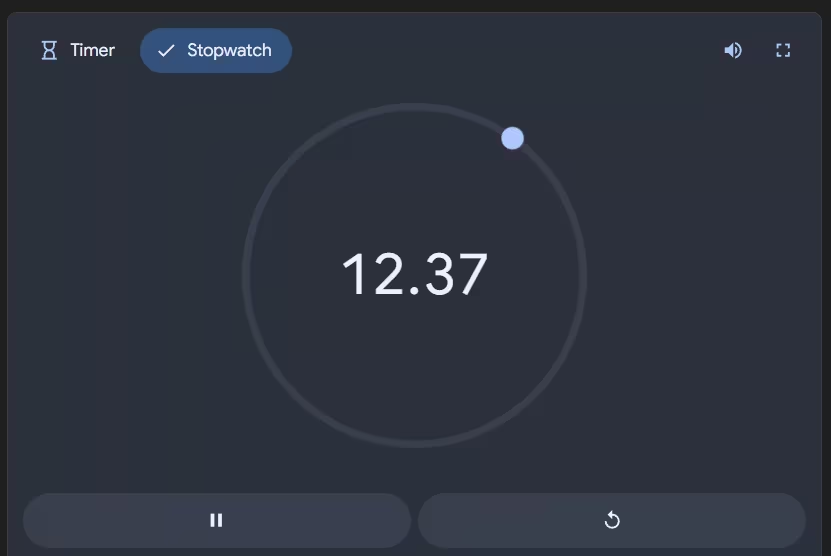
- Have a timer ready. This could be a physical stopwatch or one available online.
- Take the test while seated upright.
- Take a deep breath, filling the lungs completely.
- Pinch your nose and start the timer.
- Stop the timer when you feel a very strong urge to exhale.
- Exhale.
What Do My Results Mean?
If you were unable to hold your in breath for 30 seconds and experience breathlessness or a persistent cough, it should be followed up with a medical professional.
Beyond that, the breath holding standards can be seen below.
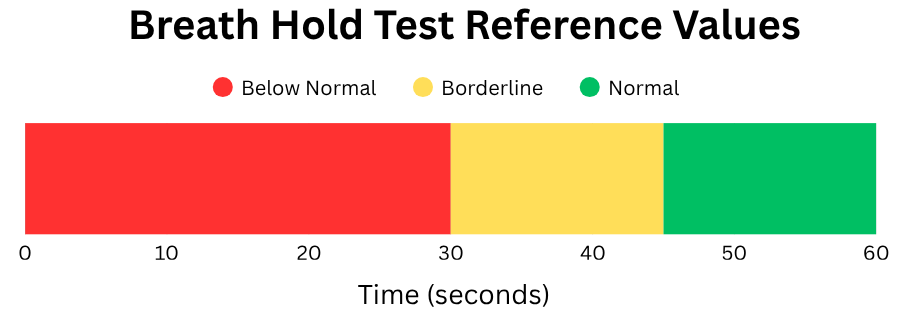
Being able to hold your breath in for at least 45 seconds indicates good lung function and respiratory efficiency.
This is measuring your CO2 tolerance, an ability to handle the build up of carbon dioxide in the body. At the same time carbon dioxide rises, your body is also facing a gradual decrease in oxygen levels. It is therefore also assessing your ability to efficiently use the oxygen you have in your system.
A 2026 paper [1] showed that 90% of participants who could hold for at least 45.5 seconds had normal spirometry results. However, 43% of participants who couldn’t hold for 45.5 seconds also had normal spirometry, so the breath hold test is not diagnostic.
Instead, it is a potential screening tool for those who are unlikely to require additional spirometry testing.
Home Spirometry Test
The most common spirometry test is the forced exhale, which can be done using a digital spirometer at home.
The spirometry test should be done as follows:
- Ensure you are not out of breath before you begin and avoid doing this within 2 hours of intense exercise.
- Enter the necessary information into the digital spirometer (age, sex, height, ethnicity)
- Take a large breath in, filling your lungs completely
- Put your lips round the outside of the mouthpiece and blow as hard as possible
- Continue blowing until every last bit of air is out your lungs (usually over 6 seconds)
My device (Contec SP70B) will then beep and display an output report as shown below.
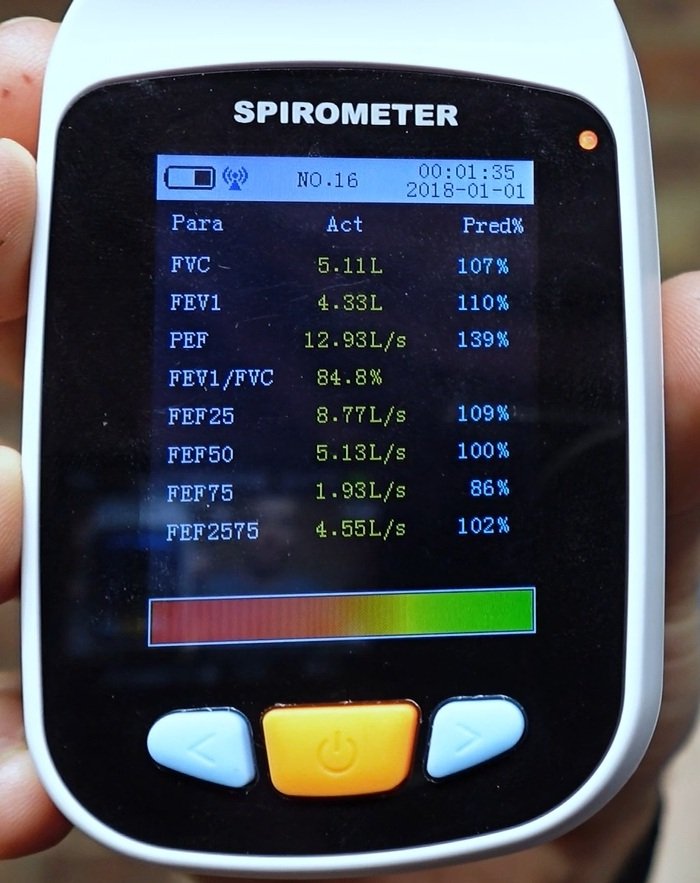
Having entered my age, sex and height, the values of interest are on the right hand column titled “Pred%”. This is how I compare to the reference data, and these values are the ones most commonly used for interpretation. A full evaluation of these results should be conducted by a medical professional, however my main interest is in tracking FEV1.
FEV1 and Mortality Risk
FEV1 stands for Forced Expiratory Volume, and the “1” indicates it’s the volume of air exhaled in the first second.
A 2017 paper [2] showed that in individuals without prior lung disease, both FEV1 and FVC (Forced Vital Capacity, the total air exhaled), as a percentage of predicted values, are correlated with all-cause mortality.
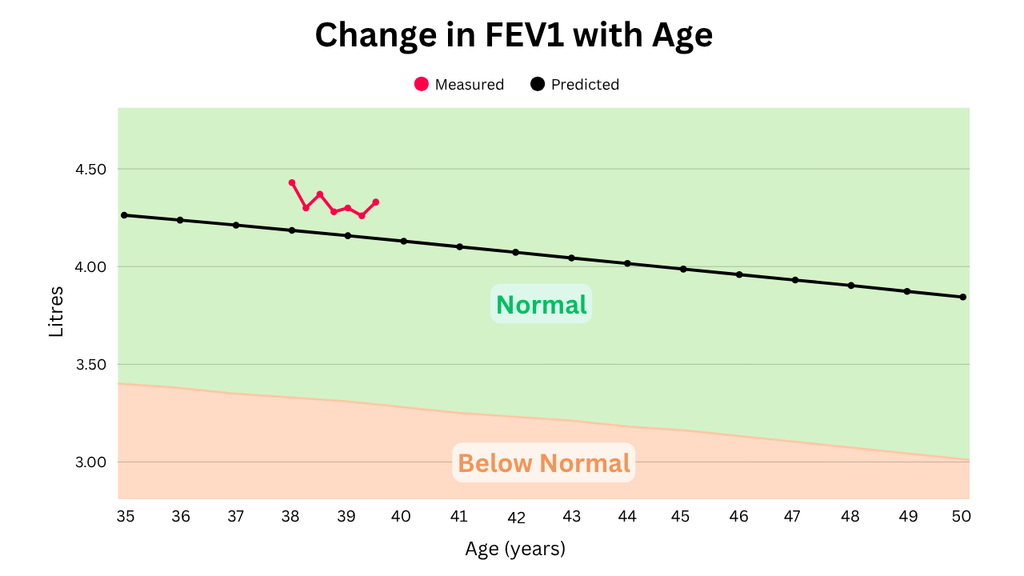
This is the reason I choose to track my FEV1 every few months. Below you can see that I sit above the line (roughly 108-110% of predicted). The decline over the next few years is ~7%, so if my FEV1 declines by less than that, I could say that I am ageing well.
For trend-monitoring I believe a home spirometer is sufficient, while for diagnostic purposes this test should be supervised by a medical professional.
References
[1] Diagnostic accuracy of the Voluntary Breath-Hold Test to discriminate normal vs. abnormal spirometry: a two-gate study, G.Veras, A.Veras, T.Bartholo, A.Lopes, C.da Costa, R.Rufino, 2026
[2] FEV1 and FVC predict all-cause mortality independent of cardiac function – Results from the population-based Gutenberg Health Study, Magnussen et al. 2017
