
VO2 max is a measure of the maximal volume of oxygen your body can use and it’s a good indicator of cardiovascular fitness. A true VO2 max test is conducted in a lab and involves exercising to failure while wearing a mask. However, there are simple tests that can provide an estimate of your VO2 max. One such example is the Astrand-Ryhming test [1], conducted on an exercise bike.
How to do the Astrand-Ryhming Test
The test can be completed on an exercise bike with variable resistance and a display that includes the number of Watts produced while exercising.
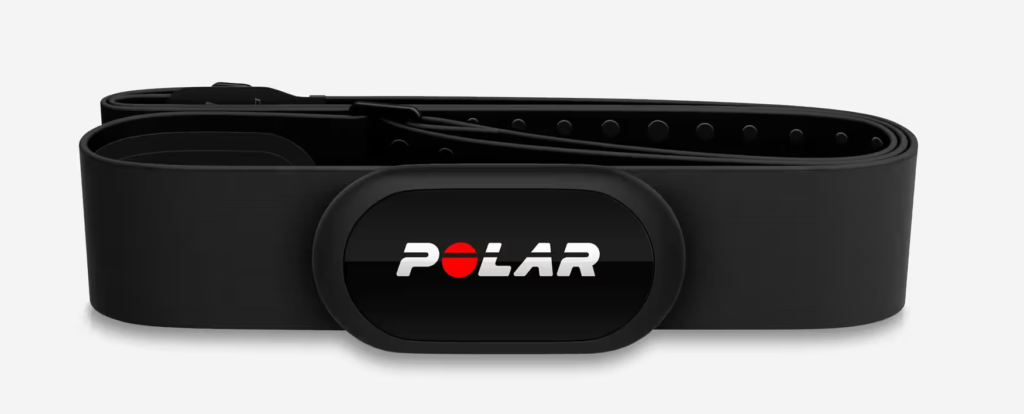
You will also need a way of continuously measuring your heart rate. Ideally this would be a heart rate chest strap, but a wearable or the heart rate sensors on the handles of the exercise bike may be used instead.
Choosing the resistance
The resistance should be set so that your heart rate in the final minute is between 125 and 170 beats per minute. If that means nothing to you, you’re not alone. To determine what resistance you should start with, I recommend using my spreadsheet calculator. The spreadsheet can either be downloaded as a Microsoft Excel file, or you can create a copy of the original to edit for yourself.
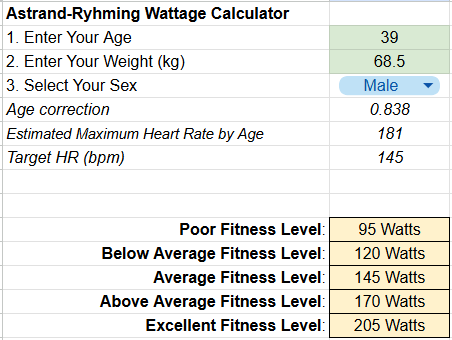
For example, I can set my age (39), weight (68.5kg) and sex (Male) and I can see that if I believe I have an Above Average Fitness Level, I should aim for 170 Watts. This is based on a target heart rate of 145 bpm, which has a 20 bpm buffer either side, in case I’ve over- or under-estimated my fitness level.
Warming up
After adjusting the seat height to a comfortable level, begin with several minutes of light pedalling using a moderate resistance. The full test will require you to pedal at 50 rpm. A cadence of 50 revolutions per minute will feel like cycling up a hill rather than on flat ground, and your leg muscles will be worked.
Use the average Watts obtained from the previous section to adjust the resistance. You want the display to be close to the desired Wattage, in my example 170 Watts, while pedalling at 50 rpm. Note down the resistance level, as this will be the level you will set for the main test.
Once you feel warmed up, allow 2-3 minutes to rest before moving on to the main part of the test.
Starting the test
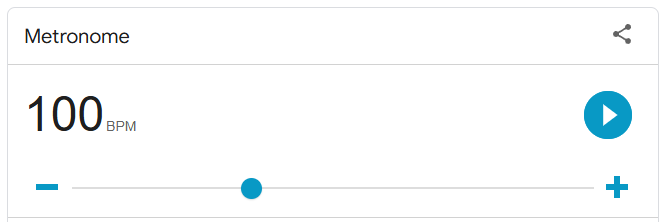
Begin by setting a timer for six minutes. Consider using a metronome set to 100 bpm to keep yourself in time with the required cadence of 50 rpm.
Ensure your chosen heart rate measurement device is working and you can either read it clearly, or store the data for future use.
Start the timer, and begin pedalling at 50 rpm. Try to find a comfortable position, as shifting your body towards the end of the test may influence your heart rate and final result.
If you only have access to a live view of your heart rate, you will need to gauge the average value for the final minute of the test (5:00 to 6:00).
Here is an example of the required cadence for the test.
After the test
Once the test is completed, you should have two numbers:
- Average Watts across the duration of the test
- Average heart rate in the final minute of the test*
*Your heart rate should not vary by more than 5 beats per minute in the final two minutes of the test. If it does, you will need to extend the test a further minute.
These two numbers, alongside age and weight, can be input into the VO2 max calculator. Again, you will need to download it in Excel or create a copy in Google.
If your heart rate was not between 125 and 170 bpm in the final minute, the test is not valid. If this is the case, it is best to repeat the test on a different day, modifying the resistance accordingly.
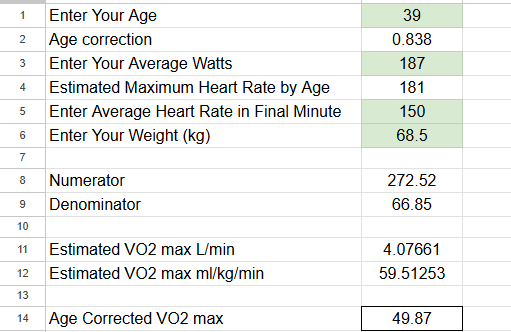
What do my results mean
Your results are best compared relative to others of the same age and sex. Below is a set of normative data for VO2 max for both men and women.
What constitutes “average” can vary between research studies due to the population samples they use. This dataset is on a US population, whereas similar studies in Norway have shown a much higher average VO2 max with age, closer to the light green “Above Average” band from the US dataset.
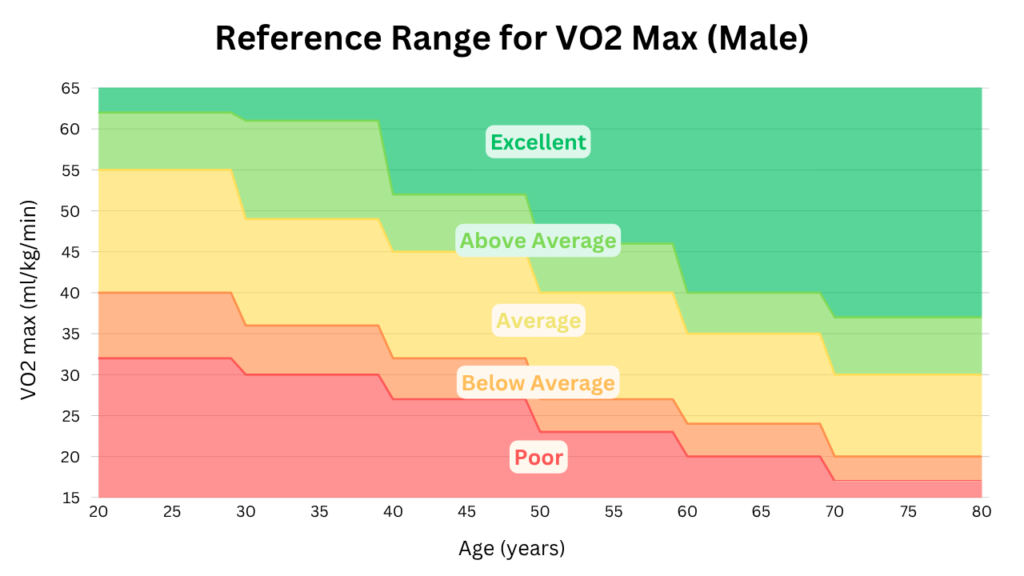
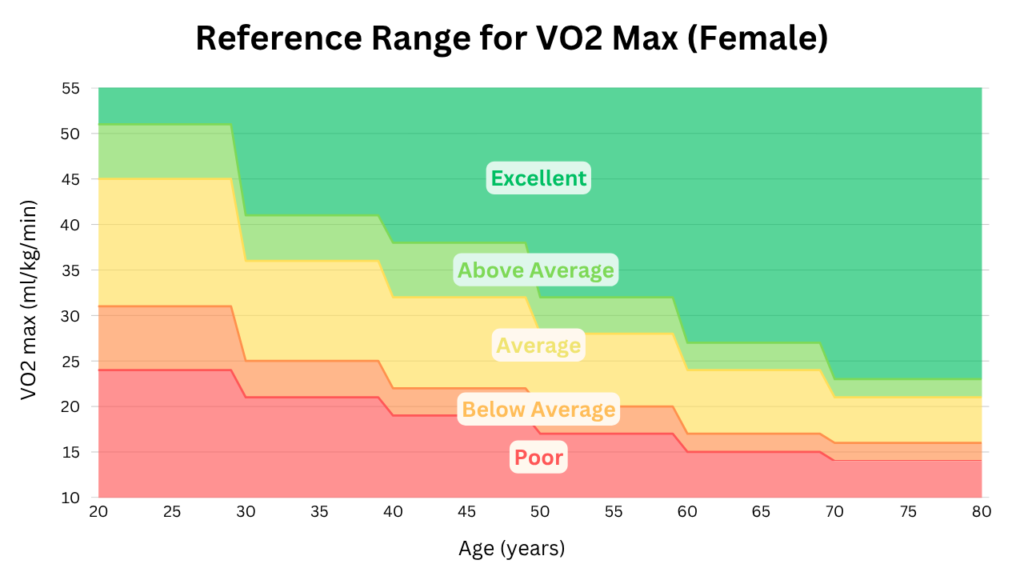
Elite male athletes average 55-65 ml/kg/min while endurance specialists are able to reach 75-85 ml/kg/min. Below is the female reference range, where values are typically 30% lower.
If you aren’t satisfied with your score, I have good news. It’s possible for sedentary or recreationally active people to improve their VO2 max by 15-20% with several months of consistent training [2]. This is particularly important because higher VO2 max is associated with a reduction in all cause mortality [2,3].
Tracking VO2 max over time
There is a very well established decline in VO2 max with age, and that happens regardless of fitness level. The difference is that a fitter individual will remain at a higher level relative to the unfit individual as they both age. People typically lose 1% of their VO2 max every year after the age of 30 [2] and this is partially down to changes to maximal heart rate [4]. This means that even if you maintain your activity levels, you will see a decline with age.
It’s worth taking a simple test like this once a year and making a note of your scores. Here I’ve included my results, which come from a range of different tests including the Astrand-Ryhming cycle test.
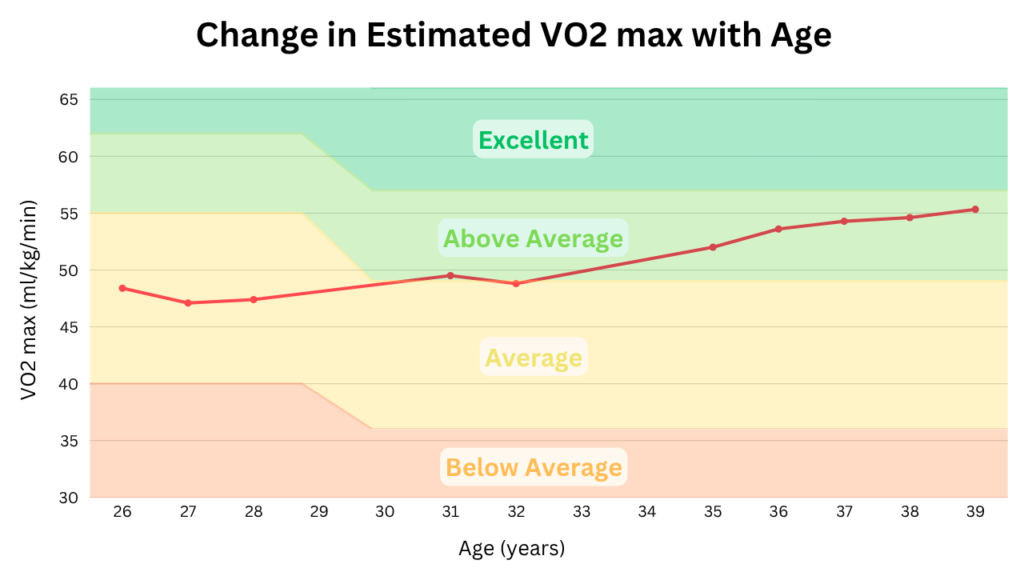
While the literature would suggest a decline after I turned 30, I have since made a conscious effort to exercise more in order to reverse that. My most recent tests, aged 39, have given me a predicted VO2 max score of 55.3 ml/kg/min.
[1] A nomogram for calculation of aerobic capacity (physical fitness) from pulse rate during sub-maximal work. Astrand & Ryhming, 1954.
[2] Survival of the fittest: VO2 max, a key predictor of longevity? Strasser & Burtscher, 2018.
[3] Impact of cardiorespiratory fitness on all-cause and disease-specific mortality, Harber et al. 2017
[4] Physiologic basis for the age-related decline in aerobic work capacity, Higginbotham, Morris, Williams, Coleman, Cobb, 1986.
