

One of the most popular diets when I started getting into nutrition 20 years ago was If It Fits Your Macros (IIFYM). The idea was to focus on eating a certain amount of protein, carbohydrate and fat each day, with no “forbidden foods” so long as those targets are met.
It allows for a level of flexibility that other diets often lack. Keto? Sorry, no bread for you. Vegetarian? Put that chicken breast down. Paleo? There goes your dairy.
After 15 years of on and off food tracking, I’ve come to believe there is a better option out there. I see it as an extension of IIFYM, with an added emphasis on micronutrients. I call it, If It Fits Your Micros.
If It Fits Your Micros – The Diet
The basic premise is the same: there are no foods that are off limits on the diet. However, rather than simply meeting your requirements for protein, carbohydrate and fat, you also need to consider your micronutrients.
That means reaching the Recommended Daily Intake (RDI) for a set of micronutrients, which are as follows:
- Vitamins: A, B1, B2, B3, B5, B6, B7, B9 and B12, C, D, E and K
- Major minerals: Calcium, Chloride, Magnesium, Phosphorous, Potassium, Sodium, Sulfur
- Trace minerals: Chromium, Cobalt, Copper, Fluoride, Iodine, Iron, Manganese, Molybdenum, Selenium, Zinc
- Other essentials: Omega 3, Omega 6, Choline, Fibre
Overwhelmed? Don’t worry, there’s a simple way to track all of these.
If It Fits Your Micros – The Tracking
Back in 2019 I graduated from tracking my food with My Fitness Pal, to using the app Cronometer. The difference was that, as long as you select the generic version of a food, it will come with complete vitamin and mineral information.
In practice that means you’re choosing entries with names like Bread, Whole Wheat, Commercially Prepared and Pasta, Dry, Unenriched and accepting that it won’t perfectly align with the specific brand you’re really eating.
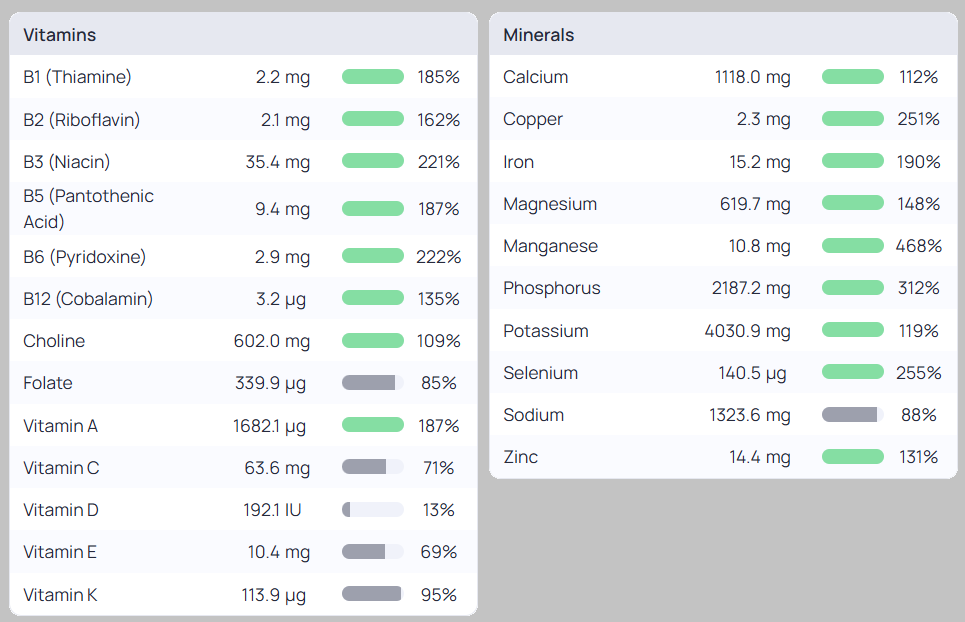
Hovering each of these will tell me the daily contributions from my food – for example, the 95% of my RDI of Vitamin K is predominantly from two foods, milk and frozen peas. However, a single day is often too noisy, and trends are better measured across weeks or even months.
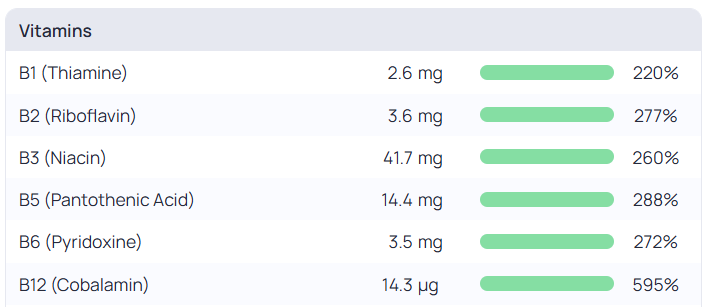
The free version of Cronometer provides a view of the Last 7 days, which aggregates data and shows where you are relative to the RDI. Below you can see I’m comfortably meeting the RDI for the B vitamins, and hovering it I’m able to see why that is. A few servings of chicken liver this week has provided me with 60% of my Vitamin B2, 53% of Vitamin B5 and 280% of Vitamin B12(!).
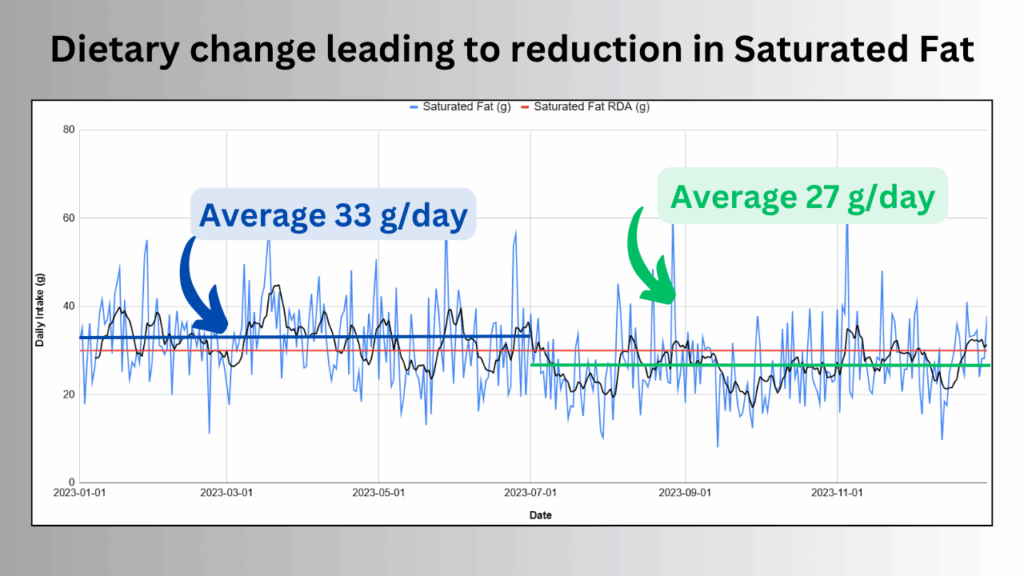
Personally I like to go a stage further, and I export the data to a Google Sheet and make graphs like this (annotated in Canva). Here I’ve plotted my daily saturated fat intake, added a rolling average in black, and the RDA of 30 grams as a red line. You can see that, prior to July 2023, I was 10% above the RDA, and since then I’ve been 10% below it.
Can’t I Just Take Supplements?
When people hear vitamins and minerals their mind immediately goes to popping a daily multivitamin and getting on with their day. Technically, yes, you can take a supplement everything, but it’s not in the spirit of the diet.
When it comes to food tracking I like to think of three different levels:
- Level 1: Only tracking calories
- Level 2: Tracking your macros
- Level 3 (this diet): Tracking your macros & micros
Very broadly, counting calories would control your scale weight, your macros would help with body composition, and your micronutrients unlock a level of internal health that may only show up on blood tests.
I believe there is a level 4 (and 5!), which might include nutrient timing, additional tracking like amino acids, and compounds that exist in certain foods, such as curcumin (found in turmeric) and sulforaphane (from broccoli sprouts).

For that reason, taking supplements is not delivering the same benefits as a diet rich in real foods. The one exception would be vitamin D. While it exists in foods like tuna, salmon and eggs, and is produced by the body from sun exposure, supplementation is often required to meet your daily needs – especially in winter months.
If It Fits Your Micros – The Results
I’ll finish by showing you the diet in action. This is a step-by-step approach to implementing IIFYM into your lifestyle.
Step 1
It starts by logging your foods consistently, making sure to log the generic version of foods to avoid the need for data cleaning. Remember, you need an app that includes vitamin and mineral content, like Cronometer. If you’re inconsistent at logging foods, it’s better to have a few complete days in a week than many partial days.

Step 2
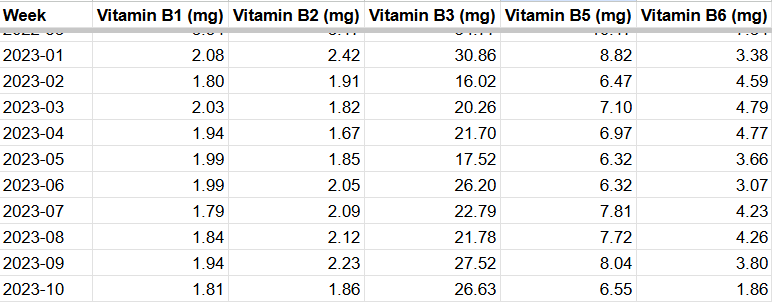
If you’re satisfied with a 7 day average, use the built in trends feature on the Cronometer app (also available on desktop). If you’re like me and want more detail, download your data as a csv and import it into a Google Sheet. From there, use a pivot table to find the average daily or weekly intake for every nutrient.
Step 3
Identify areas where you are either failing to meet the RDI, or if the value is an upper limit (salt, sugar, saturated fat) make sure you aren’t exceeding the limit.
Step 4
Identify the foods it would help to increase/decrease your intake of in order to improve your diet. Increasing a nutrient might involve an online search for “Foods high in _______”. For decreasing your intake, pay attention to the foods you’re already consuming.
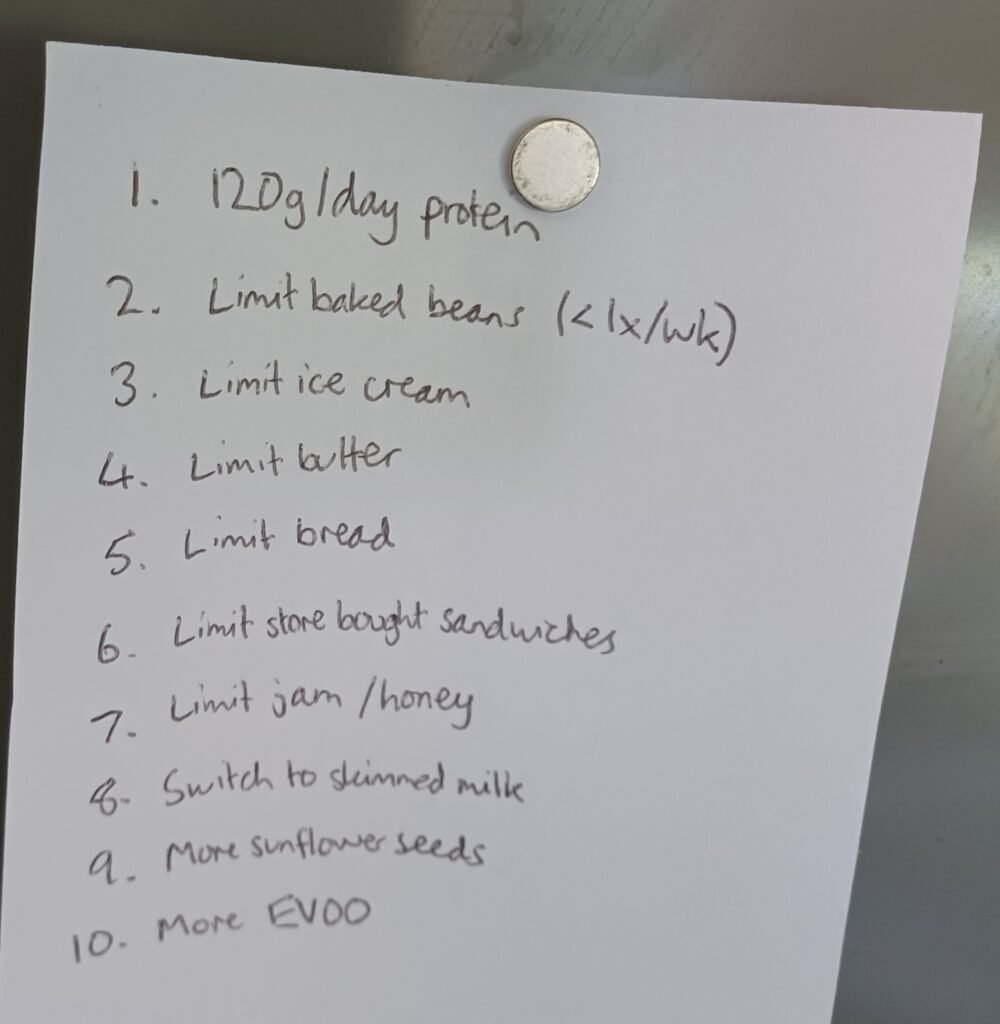
As a personal example, 12-15% of my saturated fat in Oct-Dec 2024 was coming from semi-skimmed milk. This meant taking the simple action to swap to skimmed milk for 2025.
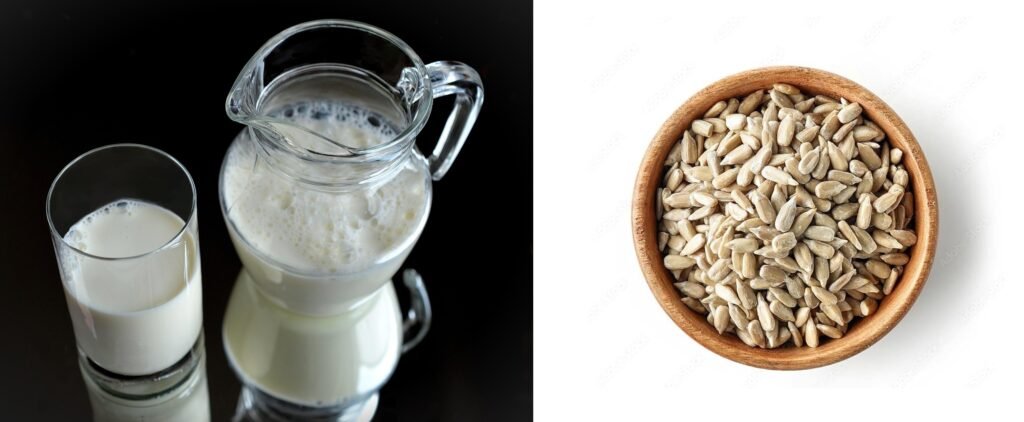
In contrast, my average intake of Vitamin E was only 13 mg of the 15 mg target. Searching online I was able to identify sunflower seeds as a suitable topping to my meals, offering 50% of my RDI in a single ounce.
Step 5
Implement the changes! While it’s tempting to completely overhaul your diet, in my experience small changes every 2 to 3 months has been the most effective. A quarterly diet assessment is a reasonable cadence and allows you time to settle into your new habits (or not!). I like to write down 6-10 changes and pin them to my fridge.
Step 6
Iterate. This isn’t a “one and done” assessment, it’s worth regularly reviewing your diet to ensure you’re where you want to be. Otherwise, over time you are likely to slip into old habits, possibly without really noticing.
Summary
For some people, diets with “forbidden” foods seem overly strict. By building on the classic If It Fits Your Macros diet to incorporate vitamins and minerals, you get an extra layer of health without excluding any food groups.
That’s not to say there won’t be foods that don’t really fit – half a takeaway pizza may well contain your entire daily limit of salt or saturated fat, but by aggregating the data by week or month, it will smooth out any nutritional “blips”.

Even if you aren’t in it for the long haul, simply download Cronometer and try logging your food for seven consecutive days and see what you find. Personally, I have the physique and blood test results to prove that an If It Fits Your Micros approach to dieting can produce some very respectable results.
Thanks for reading!
