

Your levels of inflammation can tell you a lot about your overall health. While your body has an acute inflammatory response to injury and infection, chronic inflammation may point to underlying issues. It has also been linked to a greater risk of heart disease.
Chronic inflammation could be due to excess body fat, lack of exercise, poor diet, poor sleep and many other lifestyle factors. A common way for people to measure their levels of inflammation is with a CRP blood test.
What is CRP
C-reactive protein is a protein produced by the liver in response to inflammation in the body. The blood test is known as high-sensitivity C-Reactive Protein, but is often shortened to hs-CRP or even CRP. There are two separate tests, and for detecting low level inflammation you need to be sure it’s the high-sensitivity biomarker you’re measuring.
How to measure hs-CRP
An hs-CRP blood test is a pretty standard marker that you’ve likely had measured by your doctor when feeling unwell. Since very high levels can indicate infection, it is a useful diagnostic blood test. However, for general health you are likely to need to find a private blood test, many of which are available to order online.
The marker itself is very cheap to process in the lab, so if you do purchase a private blood test it makes sense to test it at the same time as other markers, like HbA1c for diabetes risk.
Who shouldn’t measure hs-CRP
The reason you can’t rely on the results from a doctor’s check up is that hs-CRP can rise dramatically in the presence of infection or illness. It is known as an “acute phase reactant” and its ability to rise so clearly is a positive for diagnostics and a negative for general monitoring. That’s why it’s essential you avoid taking this test when you are ill or unwell.
Additionally, certain inflammatory conditions like rheumatoid arthritis and lupus would make it unreliable as a way to interpret overall health.
What do my results mean
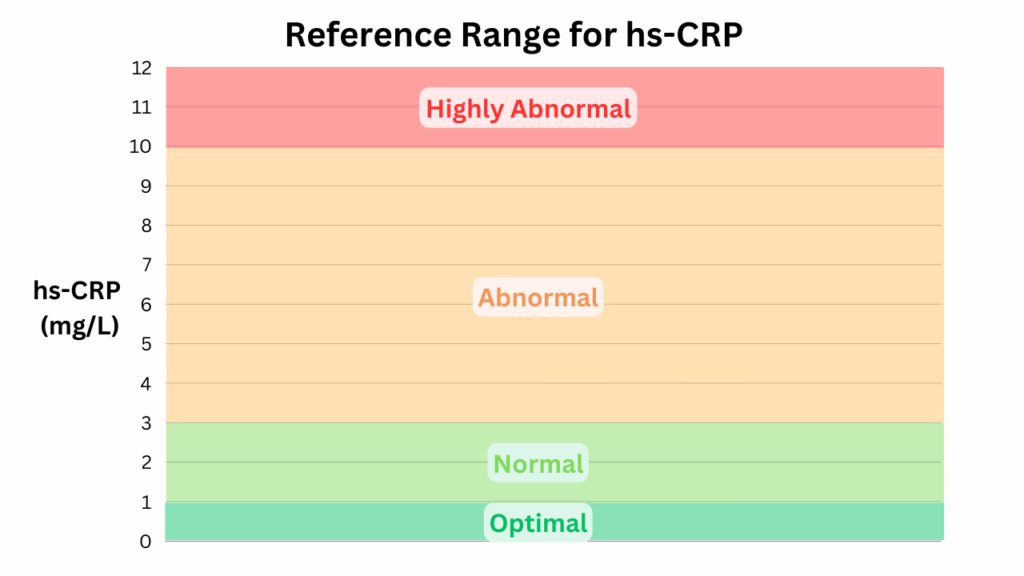
Assuming you took the test when you were well, the following values are used to categorise your result:
- Optimal range: < 1 mg/L (< 10 mg/dL)
- Normal range: 1 to 3 mg/L (10 to 30 mg/dL)
- Abnormal range: 3 to 10 mg/L (30 to 100 mg/dL)
- Highly abnormal range: 10+ mg/L (100+ mg/dL)
The results from your chosen provider should come with a reference range that looks something like this.
Note that your body may still have elevated hs-CRP for 1-2 weeks following an illness, so it really is important to take the blood sample when you’re feeling your best. It is not uncommon to see a very high level that comes right down to the normal range when tested again a week later.
Tracking hs-CRP over time
This test is worth repeating on an annual basis, and every 3 to 6 months if you sit outside the normal range.
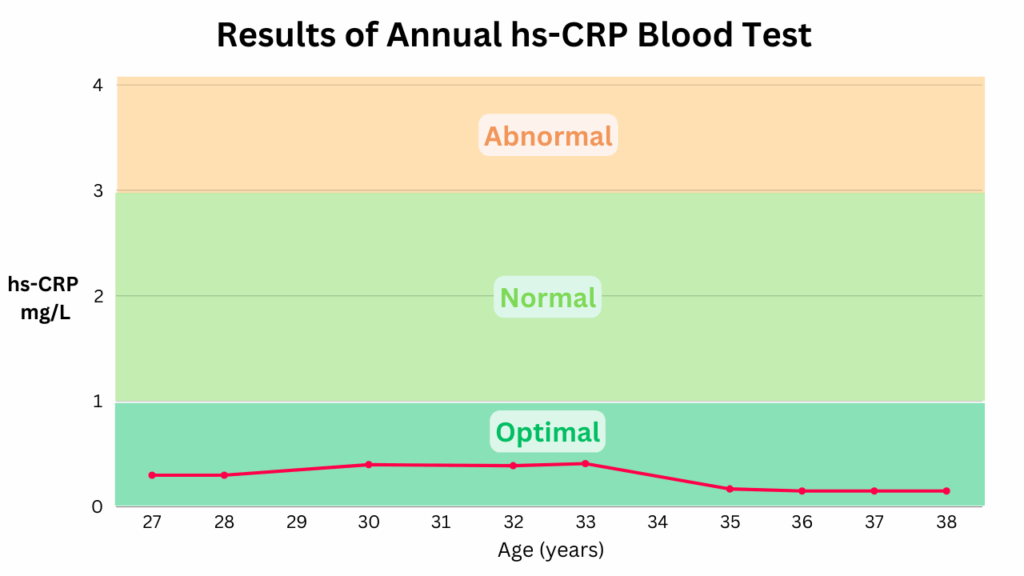
I have been tracking my hs-CRP levels since 2014 and the results can be seen below. As you can see, I have remained in optimal for the last 11 years due to my healthy lifestyle.
There is, however, one test result I’ve not included. Last year I had an undiagnosed chest infection at the time of my test, and my hs-CRP result was an incredible 65.9 mg/L. I waited a full month for it to resolve itself until testing again, and my levels came down to 0.19 mg/L.
There are several lifestyle changes that can help reduce your hs-CRP levels if you are outside the optimal range:
- Regular exercise
- Avoiding smoking
- Improving your sleep
- Losing any excess fat
- Eating an anti-inflammatory diet, incorporating plant-based foods
- Managing stress
However, it’s important to speak to your doctor if your results are severely elevated (10+ mg/L).
